

Category: Self Improvement

  • Daily Affirmations That Work: Say It Before You Feel It

    Daily Affirmations That Work: Say It Before You Feel It

    It sounds too simple to work: say a phrase to yourself every day and somehow your life starts to change. But what if that simplicity is exactly what makes daily affirmations powerful?


    Repeating a sentence over and over in the mirror felt like something out of a self-help movie montage, not something grounded or useful. But at some point I realized the power wasn’t in whether the words felt true right away. The power was in saying them anyway. Before they felt real. Before I “believed” them.

    Because sometimes, what we say , especially to ourselves , can become what we see.

    What Are Daily Affirmations?

    At their core, daily affirmations are short, intentional phrases you repeat to reinforce a mindset, belief, or emotional state you want to cultivate. They’re like mental nudges, a way to speak to yourself in the direction you want to go, instead of the place you might be stuck.

    They might sound like:

    • “I don’t have to do everything today.”
    • “I’m allowed to take up space.”
    • “It’s okay to rest.”

    You can use them in the morning, before sleep, during a stressful work day, or whenever your thoughts start spiraling. And while the idea might sound simple, it’s backed by a growing body of psychology research, including cognitive behavioral therapy (CBT), which often focuses on the connection between our thoughts, feelings, and behaviors.

    Why They Work (Even If They Feel Weird at First)

    Affirmations work a little like cognitive training. They help reroute the automatic scripts many of us play in our minds every day, the ones filled with doubt, self-criticism, or stress. Over time, repeating more supportive scripts can help soften the intensity of those default thoughts.

    You don’t need to believe every word at first. That’s not a flaw, that’s the process. It’s like planting seeds. You water them not because they’re already a tree, but because you know what they could become.

    How to Use Affirmations in Daily Life

    Let’s break it down into practical steps. Here’s how I’ve used affirmations in a way that doesn’t feel forced or awkward:

    1. Start Small
      Choose one or two affirmations that speak to where you are right now. Avoid super lofty statements that feel disconnected from your reality. Instead of “I love everything about myself,” you might try, “I’m learning to treat myself with more kindness.”
    2. Make It a Habit
      Tie it to something you already do daily. Say your affirmations while brushing your teeth, waiting for coffee to brew, or just before you open your laptop. Morning affirmations are a great way to set the tone for your day, and sleep affirmations can help ease anxious thoughts before bed.
    3. Speak Them Out Loud (If You Can)
      Speaking out loud adds emphasis , it’s like giving the thought more weight. But if that feels weird (especially around roommates or family), writing them down works too. Some people like to journal their affirmations each morning or leave sticky notes in places they’ll see them.
    4. Choose by Context
      Tailor affirmations to the part of your day or life you want to support. Here are some examples grouped by use:

    Morning Affirmations to Set the Tone

    • “Today, I give myself permission to go slow.”
    • “I can start fresh no matter how yesterday went.”
    • “I don’t need to be perfect to be effective.”

    These are especially helpful if your mornings tend to start with a flood of tasks or self-judgment. Starting the day with intention, even just 30 seconds of it, can shift how the rest of it feels.


    Affirmations for Work & Focus

    • “I bring value, even when I don’t have all the answers.”
    • “I can focus on one thing at a time.”
    • “I’m allowed to ask for help.”

    Motivational quotes for work don’t have to be loud or aggressive, in fact, the most helpful ones are usually grounded and calm. These are great to say before a meeting, presentation, or while navigating burnout.


    Daily Affirmations for Sleep & Letting Go

    • “I’ve done enough for today.”
    • “It’s safe for me to rest.”
    • “I release what I can’t control.”

    Sleep affirmations aren’t about solving problems, they’re about allowing your nervous system to slow down. Repeat them during your wind-down routine or while lying in bed.


    Self-Love & Gratitude Daily Affirmations

    • “I’m learning to treat myself with the care I give others.”
    • “There is beauty in who I already am.”
    • “I’m grateful for the small good things today.”

    Self-love affirmations are often the hardest to say, which usually means they’re the most needed. Gratitude affirmations can also help ground you when life feels overwhelming.


    Tips to Make Your Daily Affirmations Stick

    • Keep them short. You should be able to remember and repeat them easily.
    • Write them somewhere visible, a sticky note, phone lock screen, or bathroom mirror.
    • Pair them with a deep breath. A short pause adds presence and helps you feel the words.
    • Adjust the language so it feels like something you would actually say. If “I am enough” feels too vague, try “I bring something meaningful to the table.”

    Want to Go Deeper?

    If you’re still curious about how daily affirmations help, you might enjoy this post: Positive Affirmations Clear Your Mind and Shift Your Focus. You can also browse my Etsy shop if you’d like to explore printable affirmation art.
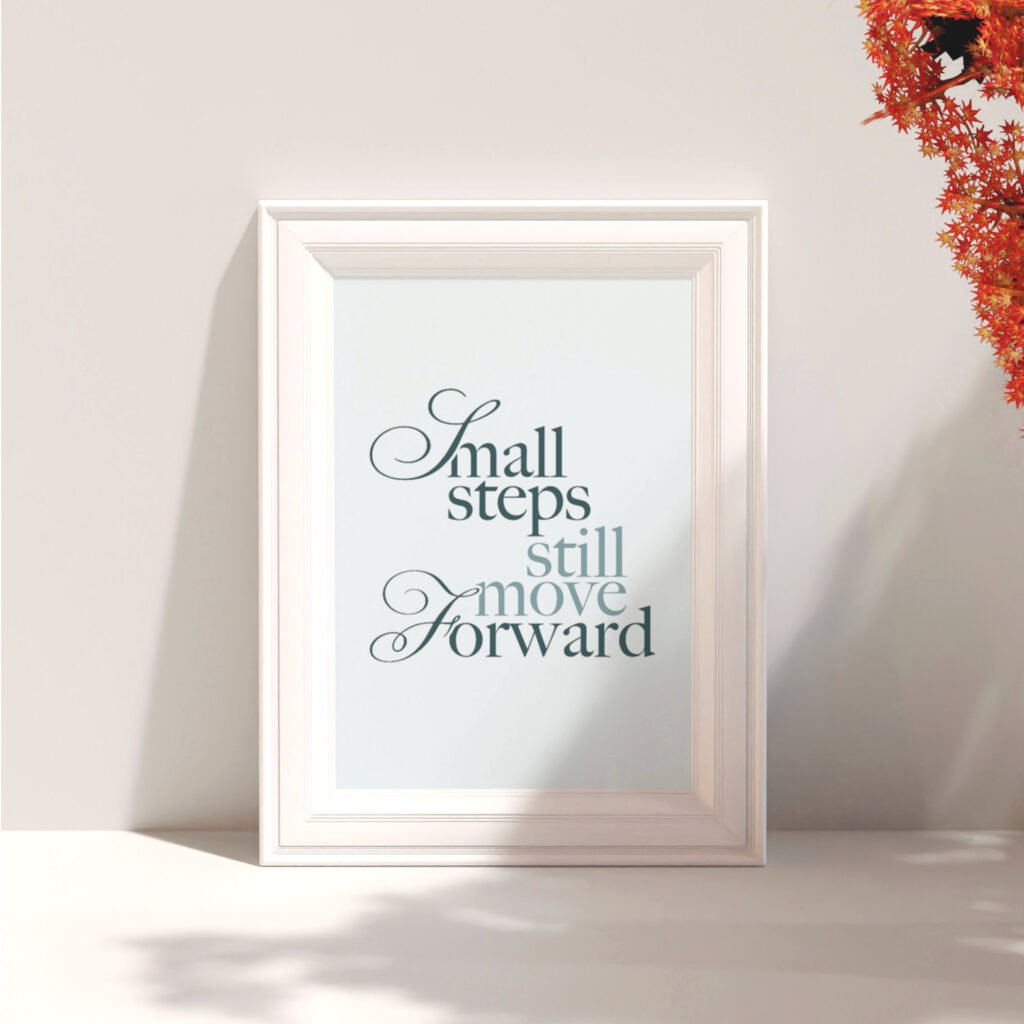

    Small Steps still move Forward daily affirmations wall art
    Small Steps Still Move Forward Poster on Etsy.com
    Thoughts are not Facts daily affirmations wall art
    Thoughts Are Not Facts Poster on Etsy.com

    Final Thoughts (And a Gentle Nudge)

    You don’t need to believe an affirmation right away for it to help you. Sometimes, the act of choosing different words , especially gentle ones, is the first step toward believing something new about yourself.

    Try choosing one affirmation from this list and repeating it each day this week. Say it even if it feels awkward. Say it especially if it feels awkward.

    You might be surprised by how a few small words, repeated with intention, can shift the way your day unfolds.


  • Positive Affirmations Clear Your Mind and Shift Your Focus

    Positive Affirmations Clear Your Mind and Shift Your Focus

    Can saying a few positive sentences each day really change how you think and feel? According to brain scans and behavioral studies, yes. Here’s what to know—and how to get started.


    What Are Positive Affirmations?

    Positive affirmations are short phrases you say—or think—to steer your self-talk in a better direction. Think of them like mental reps: “I’ll stay focused,” “I deserve some patience today.”

    They won’t magically fix your problems, but they can help your brain pay more attention to solutions instead of spirals.

    Quick History

    • 1980s: Researchers like Claude Steele and Shelley Taylor show that affirming your core values helps buffer stress.
    • 1990s: “I am” mantras go mainstream in self-help books and cassette tapes.
    • 2010s: Brain scans (fMRI) reveal that affirmations light up reward centers in the brain. [1]
    • 2020s: TikTok turns affirmations into fast, viral “3-6-9” challenges.

    So whether you’re jotting a sentence in your journal or repeating one before a meeting, you’re not just being positive for positivity’s sake—you’re using a method that’s backed by both pop culture and peer-reviewed studies.


    Do They Really Work?

    Short answer: yes—but only if they feel real, and you use them regularly.

    What They Do in Your Brain

    In one study, people were placed in an fMRI scanner and asked to repeat value-based phrases like “I care about my family.” The result? The same brain regions that light up for rewards—like when you’re looking forward to something—got activated. [1] That includes the ventral striatum and the ventromedial prefrontal cortex (yeah, it’s a mouthful).

    Basically, a well-timed affirmation can give your brain a tiny boost of energy or motivation—if it’s something that actually resonates.

    When They Backfire (and How to Fix It)

    If you’re feeling low and try repeating something like “I am amazing,” it can actually backfire. One review found that people with low self-esteem sometimes feel worse after repeating big, bold statements that don’t feel true yet. [4]

    Here’s the fix: switch to future or action-based language.
    Try “I will keep going” or “I’m learning to handle challenges.”
    Slight tweak—big difference.


    How to Choose Affirmations That Actually Land

    The biggest thing that makes an affirmation work? It has to feel at least a little true. [4]
    If it feels fake or overhyped, your brain will call BS—and it’ll just reinforce the doubt you were trying to shift.

    Here’s how to tweak your wording so it feels honest and motivating:

    If you…Try saying…Why it helps
    Feel mostly solid but want a boost“I am capable of learning new skills.”“I am” works best when you already believe it a bit.
    Struggle with low self-esteem“I will keep practicing until I improve.”Future-tense softens resistance—you’re not claiming you’re perfect, just moving forward.
    Need to calm down before something stressful“I can bring calm, breath by breath.”Ties the phrase to a real, doable action (like breathing).
    Feel stuck on a long project“Each small step moves me forward.”Progress-based language reduces pressure and builds momentum.

    4 Tips to Make Affirmations Work for You

    • Keep it short. One clear sentence beats a motivational monologue.
    • Tie it to something that matters. A value like creativity, honesty, or family gives it more weight.
    • Pair it with a cue. Say it during your morning coffee or right before a Zoom meeting.
    • Change the tense. If “I am” feels fake, try “I’m becoming” or “I choose.” That subtle shift makes it more believable.

    Example fix:
    “I am fearless” → feels off
    “I’m learning to act with courage” → feels honest and useful

    The goal isn’t to fake confidence. It’s to shift your inner voice just enough to help you show up differently.


    7-Day Affirmation Challenge

    Want to try affirmations without overthinking it? Here’s a one-week experiment.
    One prompt a day. One line. One minute to check in.

    Just use your phone’s notes app or a sticky pad—nothing fancy.

    DayPromptExample PhraseCheck-In
    1Choose a core value“I act with kindness today.”Mood before/after (1–10)
    2Use future tense“I will stay present during meetings.”Stress level before/after
    3Try self-compassion“I’m learning to forgive my missteps.”Note one small win
    4Focus on action“I can pause and breathe before I react.”Noticed a difference in how you responded?
    5Add gratitude“I’m grateful for my resilient body.”Write one thing you’re thankful for
    6Reframe a challenge“Every obstacle is data for growth.”How’d you respond to a hiccup?
    7Pick your favoriteReuse the phrase that hit bestCompare Day 1 vs Day 7 mood

    How to Do It:

    1. Pick a time cue — right after waking or during the first coffee sip.
    2. Say or write the day’s phrase 3–5 times, slowly.
    3. Log a quick metric (mood 1-10, stress 1-10, or a short note).
    4. Adjust wording if it feels fake—shift to “I will” or “I’m learning.”
    5. Review on Day 7 — look for even subtle lifts in mood, focus, or self-talk.

    By Day 7, check in: Did anything shift? Even a 1-point lift in mood or energy? That’s your signal to keep going—or start mixing in new lines.


    Final Thoughts

    Affirmations don’t need to be perfect or profound to work. They just need to feel real enough to shift your focus—away from spirals and toward something steadier. Start small. Stick with the phrases that land. And if even one of them helps you move through the day with more clarity, it’s doing its job.

    Source Notes
    1. Self-Affirmation Activates the Ventral Striatum PubMed
    2. Daily micropractice can augment single-session interventions ScienceDirect
    3. Positive Self-Talk Reduces Public Speaking Anxiety University of Guelph
    4. Self-Affirmation and Social Psychological Intervention ResearchGate

  • Does caffeine help or hurt your focus?

    Does caffeine help or hurt your focus?

    You have a deadline, so you reach for caffeine – thinking you’ll get a boost. Your focus starts to slip, your mind wanders, and now you’re behind.


    How Caffeine Tries to Sharpen the Mind

    Caffeine blocks adenosine (your brain’s “time-to-rest” signal) and boosts dopamine. At the right dose—roughly 40–200 mg—it can improve reaction time, working memory, and concentration [1].

    Research keeps repeating

    • 50–200 mg (about ½–2 cups of coffee) can boost productivity and vigilance on mentally fatiguing tasks [2].
    • Many students swear by caffeine for studying because short-term memory scores tick up after moderate doses [2].
    • Caffeine gum vs. coffee? Chewables kick in faster (≈10 min) but fade sooner.

    Where the Wheels Fall Off

    Too much—or poorly timed—caffeine can trigger the opposite of focus:

    Crash PointWhat You Feel
    250 mg+ at onceJitters, racing heart, caffeine anxiety focus dip [3]
    Afternoon refill2 p.m. high → 6 p.m. slump, caffeine brain fog
    Nightly mega-dosesSleep debt, irritability, long-term effects of caffeine on focus [3]

    Find Your “Just-Enough” Zone

    1. Start low. If coffee is new, begin near 50 mg.
    2. Time it. Caffeine peaks in 30–60 min; cut off by 2 p.m. to dodge bedtime fallout [1].
    3. Track the crash. If you spot caffeine crash symptoms—irritability, yawning—dial back 50 mg next day.
    4. Pair with protein or fat. Slows absorption and flattens the spike.

    Smarter Tweaks & Alternatives

    • Coffee-nap science: Drink ~100 mg, then power-nap 15 min. You wake as adenosine clears and caffeine kicks in—double lift.
    • L-theanine combo: A 2:1 theanine-to-caffeine ratio can smooth jitters.
    • Mushroom coffee focus blends (lion’s mane, cordyceps) swap half the caffeine for adaptogens—lighter buzz, fewer shakes.
    • Cold brew vs. hot drip: Cold brew’s lower acidity can feel gentler on the gut, letting you work longer.

    My Experience

    I personally cut back on my daily coffee due to other health issues but I still enjoy an espresso or tea from time to time. I’ve found when I do drink it – the effect is much stronger compared to my previous daily intake. So if I need that little boost, I’ll have it but I don’t rely on it.

    Takeaway

    Caffeine can improve concentration or punch a hole in it—it depends on dose, timing, and your own sensitivity. Test small, track reactions, and keep non-coffee focus tools—breathing drills, short walks—on standby.

    Source Notes
    1. Caffeine: pharmacology, clinical uses, and effects on performance NCBI Bookshelf
    2. Moderate caffeine improves vigilance and cognitive performance in healthy adults PubMed
    3. High caffeine intake is associated with increased anxiety and sleep disturbance in sensitive individuals PubMed

  • Powerful Self-Talk Quotes to Boost Hope on Tough Days

    Powerful Self-Talk Quotes to Boost Hope on Tough Days

    Simple, kind phrases to interrupt the spiral and get you breathing again.


    Bad moods don’t announce themselves politely—they spill coffee on your morning, hijack focus, and whisper worst-case stories at 2 a.m. I’ve tried powering through, ignoring the noise, even eating sweets. Some days that works; most days it backfires. What helps more consistently is compassionate self-talk: short, believable lines that soften inner tension long enough for a breath and the next small step.


    Positive self-talk quotes you can use

    Borrow what clicks, tweak what doesn’t.

    How to Use These Lines

    1. Pick one ahead of time. When you’re flooded, decision-making evaporates—pre-select your go-to phrase.
    2. Say it out loud or write it down. Externalizing the line gives it more weight than silent repetition.
    3. Pair with a breath. Slow inhale, longer exhale, repeat the script—let the body and words sync.
    4. Repeat until the volume drops. Sometimes once is enough; other times you’ll loop it for a few minutes.

    Keep Them Visible

    • Sticky note on your monitor
    • Lock-screen wallpaper
    • Index card in your wallet
    • First page of your journal

    Seeing the words beats trying to recall them when stress narrows focus.

    Self-talk isn’t magic, but it is free, fast, and available anytime. If one sentence here loosens your shoulders or nudges you toward a kinder perspective, the experiment paid off.

    Source Notes
    1. Self-affirmation improves problem-solving under stress and boosts positive mood PLOS One
    2. Brief self-compassion writing increases positive affect and decreases negative affect PDF-Journal of Positive Psychology
    3. Daily positive self-talk practice enhances happiness and lowers perceived stress Frontiers in Psychology
    4. Self-affirmation and mental health: a meta-analysis of well-being outcomes PMC

  • 7 Reflective Writing Prompts to Clear Your Mind Fast

    7 Reflective Writing Prompts to Clear Your Mind Fast

    Feeling mentally cluttered? Try this: set a timer, choose a prompt, and write without editing. Just a 3-minute brain dump can work wonders. Reflective journaling is a quick, powerful way to brain dump your thoughts – wether you use a notebook or a notes app.


    Start with micro-journaling

    1. Set a 3 minute timer
    2. Pick one of the prompts below
    3. Write until the time dings, no edits or overthinking

    That’s it. No fancy layouts, just reflective writing that fits between brushing your teeth and turning off the light.


    Prompts to get you started

    Why Bother? (Tiny Effort, Real Gains)

    • Clarity on demand – A micro reflective journal session off‑loads mental clutter and makes room for better decisions.
    • Stress release valve – The act of naming emotions and doing a short brain dump can lower perceived stress in minutes.
    • Track patterns – Looking back over a week of one‑line entries often reveals habits (good and bad) you’d otherwise miss.
    Source Notes
    1. Expressive writing can increase working‑memory capacity ResearchGate
    2. Putting feelings into words reduces distress and amygdala reactivity PDF
    3. Meta‑analysis of expressive‑writing interventions and mental‑health outcomes PMC